
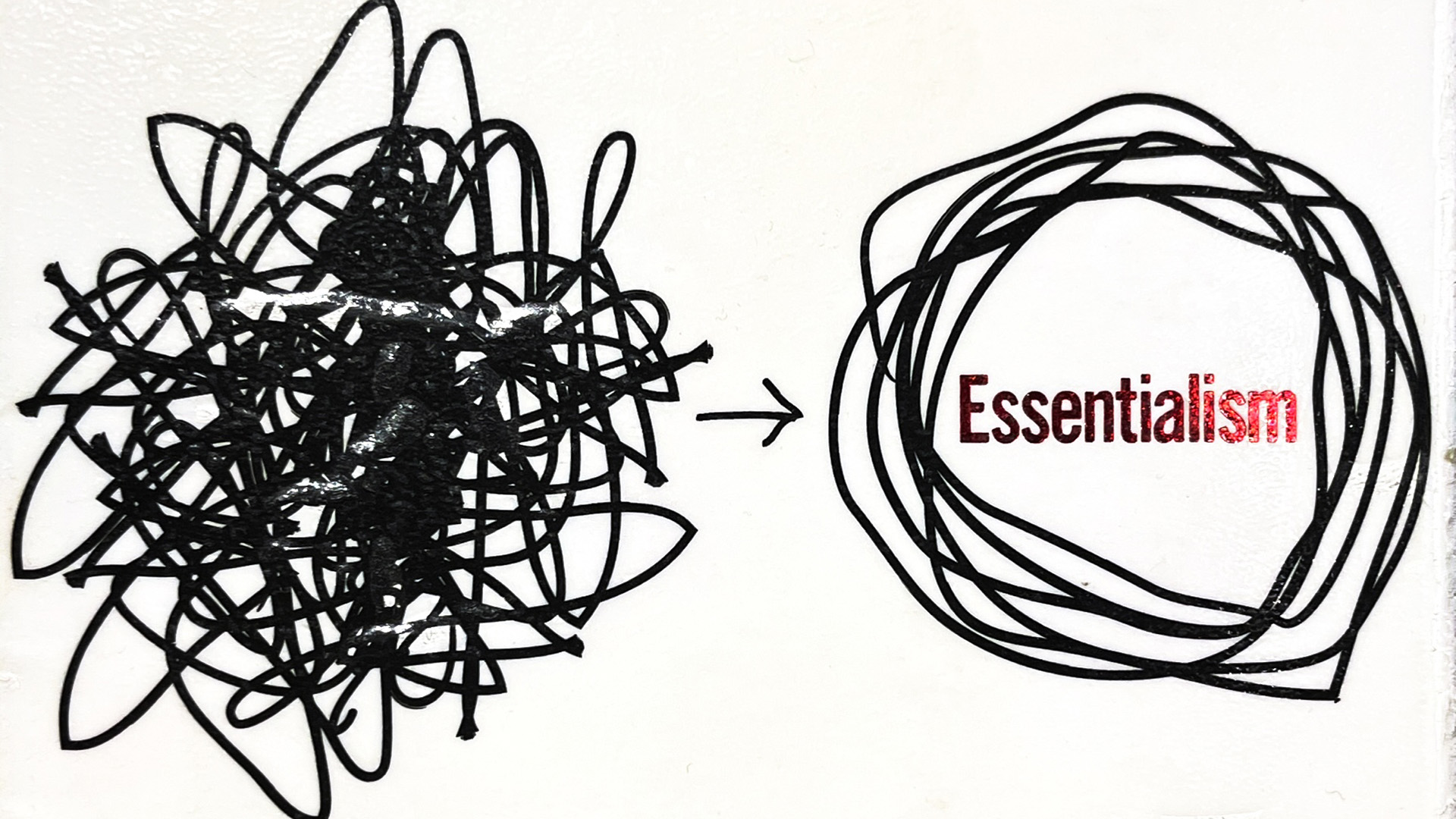
“I’m too busy to do what I really want to do.”
Have you ever felt that way?
Work requests, social drinks, checking social media… Before we know it, our time is filled with other people’s demands and “things we should do.”
We try to speed up, believing that “if I do it more efficiently, I’ll have more time.”
But that is a trap. Because the faster you go, the more tasks rush in.
What I am introducing this time is the global bestseller that cuts sharply into this “too much” problem, which can be called a modern disease: Greg McKeown’s Essentialism: The Disciplined Pursuit of Less.
This book is not merely a life hack book.
It is a book of a powerful mindset that urges a shift to a way of living where you discard the obsession that “I have to do everything” and “do only what is truly important to you.”
1. Non-Essentialist vs. Essentialist
Many people fall into the trap of “Non-Essentialist thinking.”
It is a thought pattern that seeks “More and everything” instead of “Less but better.”
The author contrasts these two mindsets.
- The Non-Essentialist: Thinks “Everything is important,” “I have to do it all,” “I’m busy,” and disperses energy little by little in every direction. As a result, they make only slight progress in any direction and are overcome by a sense of powerlessness.
- The Essentialist: Thinks “Only a few things are important,” “What should I discard?” “Is this essential?” and concentrates energy on one point. As a result, they achieve maximum results in important matters.
To illustrate, the former is like a circle where energy extends only 1 millimeter in all directions. The latter is a state where an arrow breaks through in only one direction.
Our energy and time are finite. If we disperse them, we achieve nothing; if we concentrate them, we can break through walls.
The “Disciplined” Pursuit
Essentialism is not on the level of “decluttering once in a while.”
It is a never-ending process of “constantly, with discipline, cutting away the unnecessary.”
It’s the same as organizing a closet. Even if you clean it once, if you leave it alone, clothes increase and it gets messy.
You need the discipline to keep asking “Is this really necessary?” “If I saw this being sold at full price in a store now, would I buy it?” and keep discarding based on strict criteria.
2. Reclaiming the “Power” of Choice
Why do we spend time on trivial things?
It is because we are relinquishing our “right to choose.”
When we use the words “I have to,” we make ourselves victims.
Because my boss told me to, because it’s social convention, because a friend invited me.
Psychology calls this state of merely reacting to external factors “Learned Helplessness.”
“We can ignore our ability to choose, but we cannot get rid of it.”
The author says: “Choosing” is not just an act, but a “power” that no one can take away.
The moment we feel “I am being made to do this,” we let go of that power.
“I do not choose this,” “I choose this”—only by deciding consciously like this can we regain the initiative in our own lives.
3. Facing the Reality of Trade-offs
“I want to handle work, family, and hobbies all perfectly.”
We tend to wish for that. However, Essentialism thrusts a cruel reality before us.
“You cannot have it all.”
To choose something is to discard something else. We call this a “trade-off.”
A non-essentialist thinks, “How can I do both?” And ends up with half-hearted results.
An essentialist thinks, “What do I have to give up in order to take this on?”
Southwest Airlines’ Decision
A famous example introduced in the book is Southwest Airlines.
To pursue the essence of “low prices,” they stopped serving meals, stopped assigning seats, and stopped connecting flights with other airlines.
Critics criticized that “passengers will find it inconvenient,” but the result was a huge success.
If they had sought everything, saying “We’ll serve meals, and you can assign seats, but at a low price,” it would have become an indecisive service and gone bankrupt.
Trade-offs are not pains, but strategic opportunities. What you discard highlights your uniqueness.
4. Creating “Space” to Think
Time and space are needed to discern what is essential.
We are too busy and have no time to stop and think. However, if we keep moving, we won’t even know if the direction is right.
It is said that Bill Gates took a “Think Week” twice a year, leaving work to immerse himself in reading and policy.
It was during a period when the university was closed due to the plague epidemic and he was secluded in his parents’ home immersed in thought that Isaac Newton discovered the law of universal gravitation.
Time doing nothing, boring time, time just for thinking.
These are not enemies of productivity, but indispensable investments for discerning the essence.
Creating a blank space with no plans on your calendar is preparation for doing your best work.
5. Protecting the Asset (Yourself)—The Importance of Sleep
“Working while sparing time for sleep” is sometimes considered a virtue, but in Essentialism, it is folly.
Our greatest asset is ourselves.
Lack of sleep dulls judgment, makes emotions unstable, and as a result, makes us misjudge “what is important.”
“The best performers sleep a lot.”
The author argues that “one hour of sleep generates several hours of productivity.”
Sleep is not a waste of time, but a prerequisite for increasing the next day’s performance and making correct judgments.
If you wear down the asset that is yourself, it is impossible to continue creating high value in the long term.
Mindset Design—Rewriting 95% of the Unconscious
Finally, let’s decipher Essentialism from the perspective of Mindset Design.
What this book teaches is not merely work techniques.
It is a program for rewriting the “unconscious reactions” that govern our lives.
Stop the Automatic Reaction of “Yes”
When someone asks us for something, we tend to reflexively say “Sure.”
This is due to the workings of the unconscious, which accounts for 95% of human behavior. Instinctive desires like “I don’t want to be disliked,” “I want to be thought of as capable,” and “I want to be helpful” move our mouths before we think.
To practice Essentialism, you need to notice this “automatic reaction” and press the pause button.
“Is this really worth using my life (time) for?”
By inserting that question, we can change from slaves of the unconscious to conscious choosers.
The criterion proposed by the author, “If it isn’t a clear yes (Hell Yeah!), then it’s a no,” is a powerful tool to strengthen this filtering.
Designing Life
The word “Design” comes from the Latin “Designare” (to mark out), and tracing the etymology further, it refers to “de-” (separation) + “signare” (to mark), meaning to give something a certain meaning and distinguish it from others.
To design life is to intentionally choose “this” from the chaos of infinite possibilities and cut away the rest.
A life where nothing is discarded is a life that is not designed. It is the same as just a “messy room.”
You must design your life yourself.
If you don’t do it, others (parents, bosses, society) will design your life without permission.
And that design will certainly not be comfortable for you.
Conclusion: Live Less, Live More Beautifully
Essentialism takes courage.
You have to fight the fear that people might be disappointed or that you might miss an opportunity.
But when you overcome that fear and discard the “unnecessary,” amazing freedom and silence wait there.
Time with truly important people, work you can immerse yourself in from the heart, moments you feel are beautiful.
Life is finite.
“Less but better.”
With this aesthetic in your heart, please live your 4000 weeks as something that belongs to no one else but you.


Comment