

“Unless I try harder, I won’t obtain anything valuable.”
Somewhere deep down, we believe this without a doubt.
To struggle, to clench our teeth, to endure difficulties. We have been taught that these are what “life” is, and that they are virtues.
But what if that premise is wrong?
What if the truly important things should actually be done in the “easiest way possible”?
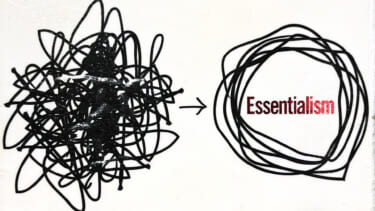
What I am introducing this time is the long-awaited sequel by Greg McKeown, who preached the importance of “What to do” in his previous work Essentialism: Effortless: Make It Easier to Do What Matters (Japanese title: Effortless Thinking: Minimize Effort and Maximize Results).
Although the Japanese title mentions “Maximize Results,” when reading from the perspective of Mindset Design, its true value is not “results.”
It lies in removing “Suffering” from life and regaining one’s natural rhythm.
1. Why do we fear “ease”?
An old bug is embedded in our brains.
“Valuable things are difficult to achieve.”
“It has value precisely because it cannot be obtained easily.”
Because of this preconception, we unconsciously choose “the deliberately difficult way.”
When we find an easy method, we feel guilty, thinking “Is it okay for it to be this easy?” and sometimes even dare to add complex processes.
The author asks:
“If this were easy, how would I do it?”
This question (Inversion) is the entrance to Effortless Thinking.
Stop glorifying difficult paths and search for the smoothest path with the least resistance.
That is not “cutting corners,” but “kindness” toward your own life.
2. Effortless State—Unloading the burden in your mind
What makes life heavy is actually not the events themselves, but our “interpretations” and “attachments.”
If you attach the weight of mental noise, no matter how much physical strength you have, you cannot move forward.
Dissatisfaction and Grudges are “Poison”
“At that time, they said that to me,” “Why is it always me…”
Dissatisfaction with things that are over and grudges against others consume a massive amount of brain memory.
The author expresses this as “like climbing a mountain carrying a heavy load.”
Holding dissatisfaction against someone is like renting out “a room in your head” to that person for free.
Let’s have them evicted immediately.
“Gratitude” is the strongest tool to expel this dissatisfaction. Just by turning your eyes to “what is there” instead of “what is missing,” the world changes from an enemy to an ally.
Turning “Endurance” into “Fun”
Continuing to do something you dislike while enduring requires an enormous amount of willpower.
However, if you link it with “something fun,” willpower becomes unnecessary.
For example, the author created a rule to “listen to my favorite podcast only when running on the treadmill.”
Then, running changed from “pain” to “fun.”
Combine an important action with an immediate reward (fun).
With this, “effort” turns into “entertainment.”
3. Effortless Action—Accomplishing without trying hard
Next is how to simplify the actual action process.
Knowing “Enough” (Defining Completion)
We often run marathons without finish lines.
Thinking “I might be able to do it better,” we repeat endless corrections and corner ourselves.
Clearly decide “what state constitutes the end (Done implies Done)” at the very beginning.
And once you reach that line, stop gracefully.
Perfectionism is the enemy of effortless. Admitting “this is enough” is also forgiving yourself.
Taking a “First Step” Like Rubbish
The more important something is, the more we make heavy plans, and become unable to take the first step.
At such times, break it down into “microsteps.”
Not “write a book,” but “open a file.” Not “exercise,” but “put on socks.”
A first step so small it’s ridiculous and impossible to fail.
However, once you start moving, the law of inertia works, and the rest proceeds on its own.
4. Effortless Results—A state where value is generated without doing anything
What Effortless Thinking aims for is not temporary results.
It is to create a state where a single action continues to generate value repeatedly—so to speak, a state like “passive income”—throughout life.
Learning “Principles”
Superficial techniques (How) become obsolete quickly, but principles (Why/What) function across eras.
Once you learn a “principle,” it becomes a tool you can use for life.
Acquiring universal wisdom through reading is the most efficient investment applicable in every scene of life.
The Infrastructure of Trust
In teams or families with trusting relationships, detailed explanations, monitoring, and maneuvering are unnecessary. Everything proceeds with “breathing in unison.”
Conversely, in relationships without trust, communication costs become enormous, and friction arises in every action.
Being sincere. Keeping promises. That is not only a moral meaning but a rational strategy to drastically lower the friction coefficient of life.
Mindset Design—Designing Friction
Reinterpreting Effortless from the perspective of Mindset Design, it can be called “Design of Friction.”
“Results are not important. What is important is how you live.”
We do not live to produce results.
However, life has “things that are truly important to me.”
If we wear ourselves down with “willpower” every time we execute them, we lose the composure to enjoy life.
Making the “Right Thing” the Easiest
True design is minimizing the friction of “actions that are like me” to the limit and increasing the friction of “actions that are not like me.”
- If you want to read, leave the book open on the desk (decrease friction).
- If you don’t want to look at social media, delete the app or set it to require a login every time (increase friction).
Making the Unconscious an Ally
As this site repeatedly conveys, 95% of our actions are unconscious.
The effortless state is a state where this unconscious (autopilot) is proceeding in the direction you desire on its own.
No one psyche themselves up saying “Okay, I’ll do my best” to brush their teeth.
Bring the things important to you to the state of “I feel bad if I don’t do it” or “I do it unconsciously,” on the level of brushing teeth.
If you do so, life will automatically become rich without effort.
Conclusion: Life is not an ascetic practice
Let’s liberate ourselves from the curse that “life is painful.”
It is possible to live lightly, with a cool face, like riding a wave.
Unload the heavy burden, remove the pebble in your shoe, and ride the tailwind.
Minimize effort, and with the surplus energy, savor this moment now to the fullest.
Now is the time to shift to such a “light way of living.”

Comment