
We are constantly being chased by something, every single day.
From the moment we wake up, we check smartphone notifications, skim through news on the commuter train, chase email replies during work, and at night, we scroll through SNS looking at the “success” and “fulfillment” of others, vaguely feeling that our own lives are fading in comparison.
“I must live more efficiently,” “I must acquire more new skills,” or “I’m going to be left behind.”
Where does this unidentified sense of impatience come from?
Why do we feel we have “no time” and “no margin” to such an extent, even though we live in an era that is historically richer and safer than ever before?
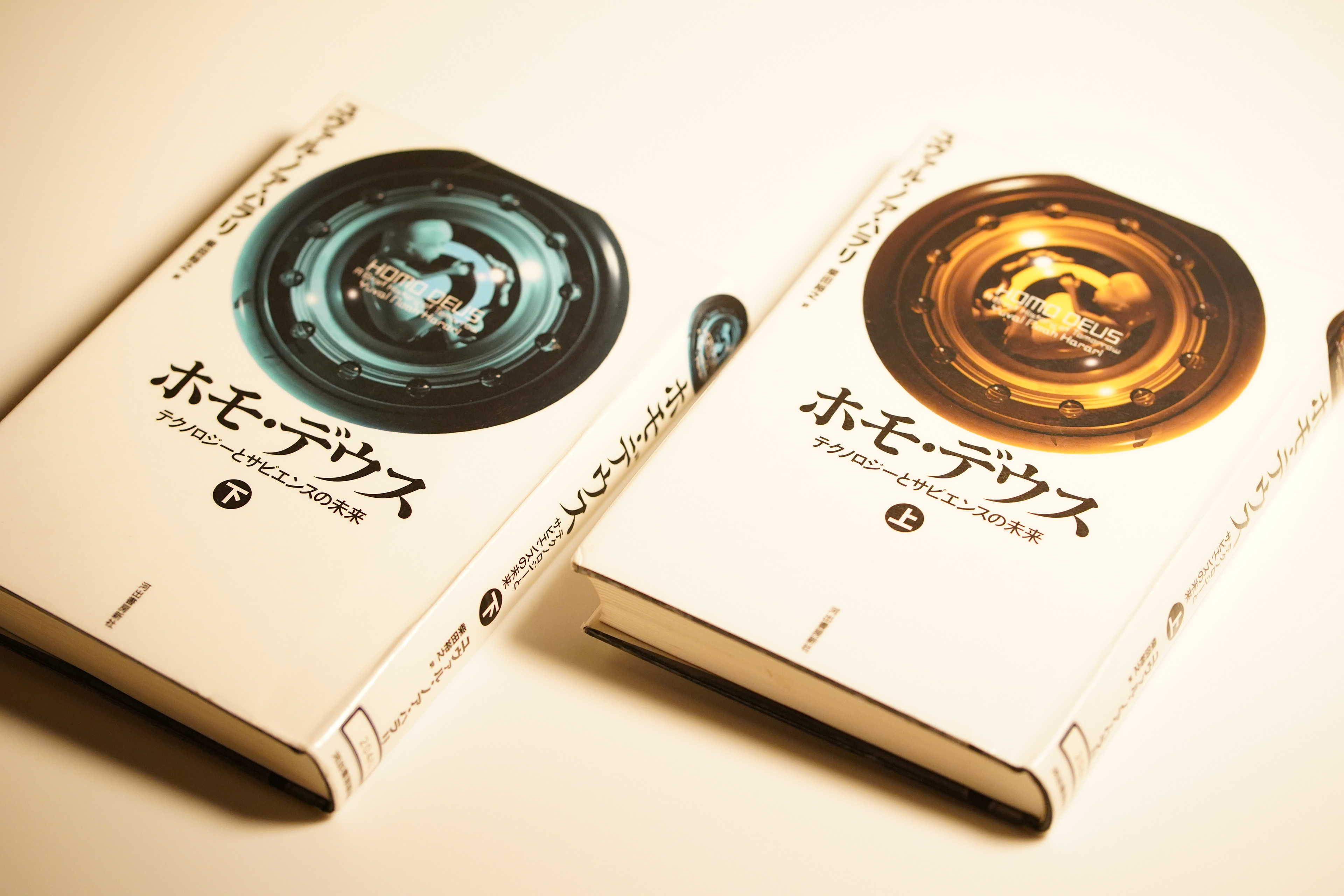
The answer to this is exposed from the dual perspectives of human history (macro) and biotechnology (micro) in Yuval Noah Harari’s Homo Deus.
This book is often introduced as a book of “future predictions,” but for Mindset Design readers, it holds a much more urgent meaning.
This is a book of cruel “revelations” that unravels “why we cannot live by our own will.”
At the same time, it is also the “key” to escaping the prison of the unconscious.
In this article, I will deeply interpret the shocking facts presented by Harari from the perspective of our daily lives and the design of our mindset (thought patterns).
- Prologue: The Modern Covenant “Abandon Meaning, Acquire Power”
- Shock #1: The Collapse of the “Faith” in Free Will
- Shock #2: The “Experiencing Self” and the “Narrating Self”
- Shock #3: The Rise of the New Religion “Dataism”
- Mindset Design: Strategies to Live Without Being Hacked
- Conclusion: It is Not “Technology” but “Mind” That Should be Upgraded
Prologue: The Modern Covenant “Abandon Meaning, Acquire Power”
First, let’s start by questioning the “premise” of the modern society we live in.
According to Harari, modern society is built upon a single gigantic covenant. That is the covenant to “abandon meaning in exchange for acquiring power.”
In the past, humans were beset by uncontrollable misfortunes such as famine, plague, and war, but there was “meaning” such as “God’s will” or a “cosmic plan.” By believing that “there is meaning in this suffering,” people maintained peace of mind.
However, modern humans killed God and chose science and economic growth (= power).
As a result, we are overcoming hunger and disease, but as the price, we have lost the “objective meaning of life.” We face the cold fact that the universe has no script, and our lives are nothing more than a chain of physical laws and chemical reactions.
To fill the void of meaning, we continue to seek “growth.”
If we earn “more” and gain “more” knowledge, we will surely be satisfied someday. The modern capitalist society is what keeps this wheel turning in that belief, and it is the true identity of our impatience.
Shock #1: The Collapse of the “Faith” in Free Will
The sole stronghold of modern society (Liberalism) is “individual free will.”
“Follow your heart,” “The customer is always right (the customer’s desire is the correct answer).” These are all based on the faith that human inner emotions are the source of meaning and authority.
However, Harari dismantles this final sanctuary with the latest scientific findings.
Emotions are Not “Magic” but “Calculations”
We feel emotions like “I like this person,” “I want to eat this,” or “I have a bad feeling about this” as something special unique to us, the voice of the soul.
However, viewed from the perspective of life sciences, these are merely “biochemical algorithms.”
“Emotions are not a mystical spiritual phenomenon. They are biochemical algorithms that all mammals use to calculate probabilities of survival and reproduction.”
In the ancient savannah, if you logically pondered “should I flee or fight” when encountering a lion, you would be eaten before the calculation was finished. Therefore, the brain instantly performs pattern recognition, generates fear, and orders the body to “Run!”
Or, when finding high-calorie fruit, it releases dopamine saying “Eat!”
In other words, your “intuition” is the “output result of a survival probability calculation program” that has evolved over millions of years.
Here arises a fatal problem.
This algorithm was optimal for surviving in the savannah, but it is an outdated OS riddled with bugs for modern urban life.
- Wanting unlimited sugar and fat when seeing them (because were once precious energy sources)
- Being excessively concerned about others’ evaluations on SNS (because being out of the pack meant death)
- Becoming aggressive towards unknown others (because outsiders were enemies)
This is what we repeatedly refer to in Mindset Design as “95% is unconscious.”
“I want to diet but end up eating,” “I want to study but end up looking at my smartphone.” This is not because your will is weak.
It is a state where ancient algorithms are hacked by the modern environment (convenience stores, smartphones, SNS) and malfunctioning.
If we just “follow our hearts,” we will undoubtedly fall into the trap of dependency created by the system.
Because the algorithms of Amazon, Netflix, and Google know the quirks of your biochemical algorithms better than you do yourself.
Shock #2: The “Experiencing Self” and the “Narrating Self”
Furthermore, Harari points out that even our sense of “I” is not singular.
According to psychological experiments, there are at least two selves within us.
- The Experiencing Self: The consciousness that feels pleasure and pain in the moment (Present)
- The Narrating Self: The consciousness that edits past experiences and creates stories (Memory)
In the famous “Cold Water Experiment,” subjects were given two options:
A: “Put your hand in cold water for 60 seconds”
B: “Put your hand in cold water for 60 seconds, then put your hand in slightly warmer (but still cold) water for 30 seconds”
Many people remembered B as “better” and chose B if they were to try again.
This is despite the fact that the total duration of pain is longer in B.
The “Narrating Self” creates memories based only on the average of the “peak” (intensity) and the “end” (conclusion), ignoring the duration (Peak-End Rule).
We tend to sacrifice the happiness of the “Experiencing Self” in this moment to pursue careers and status (stories that can be told later) for the “Narrating Self.”
Waiting for food to get cold for an “Insta-worthy” shot, or sacrificing current health for a future resume, is the rampage of the “Narrating Self.”
Shock #3: The Rise of the New Religion “Dataism”
And what comes after the collapse of Humanism is “Dataism.”
This is the ideology that views the entire universe as a “flow of data” and sees even life phenomena as a form of data processing.
“The commandment of Dataism: Record what you experience. Upload what you record. Share what you know.”
We are now following this commandment with terrifying faithfulness.
When facing a beautiful sunset or a delicious meal, we prioritize taking a picture with our smartphone and sharing (datafying) it over deeply savoring (experiencing) it.
Why?
Because in the world of Dataism, experiences that are not shared are deemed valueless.
Connecting to the massive data processing system called the Internet and flowing information is good, and being disconnected from it means death.
We think we are using the system, but in reality, we have been degraded to “chips” for the system.
Our role is to generate and process data. Not being able to let go of our smartphones is not merely an addiction, but because we have become devout believers in this new religion.
The future of being “upgraded” has two paths.
One is “Techno-Humanism.” The path of directly modifying the human brain to enhance consciousness and counter AI.
The other is “Dataism.” The path of discarding humans themselves as obsolete technology and surrendering to the flow of pure algorithms.
Either way, there is no place for “us” as we are now.
A fall into the “Useless Class,” which becomes economically and militarily worthless, awaits.
Mindset Design: Strategies to Live Without Being Hacked
Reading this far might make you feel despair.
Are humans just algorithms, is will an illusion, can we not beat AI, and are we destined to be swallowed by the waves of data?
But Harari also says this:
“The aim of studying history is to liberate yourself from the past.”
If we know the mechanisms by which we operate, we can conversely use them.
When we incorporate the insights of Homo Deus into the methods of Mindset Design, three concrete actions come into view.
1. Observe “Yourself” (Strengthening Metacognition)
Harari himself is famous for practicing Vipassana meditation for two hours a day and going on retreats for two months a year.
Why does one of the world’s greatest intellects have so much “time producing nothing”?
It is to witness the moment the algorithm within him activates.
When anger arises, instead of identifying with it as “I am angry,” objectively observe it as, “Oh, the defense instinct algorithm has activated. As a physical sensation, my chest is getting hot.”
Holding this perspective of the “observer” is the only way to escape the intervention of automatic pilot (the unconscious) and stop the rampage of the algorithm.
Admitting that “Self = Algorithm” is not resignation, but the first step to sitting back in the driver’s seat.
2. Strictly Filter Input
If we are data processing systems, the law of GIGO (Garbage In, Garbage Out) applies.
If impatience or a sense of lack is being output, it is undoubtedly because you are inputting such data.
In the age of Dataism, the most scarce and valuable resource is “Attention.”
Corporations and apps are desperate to steal your attention.
- Turn off all notifications
- Prohibit aimless web surfing
- Mute accounts that make you anxious
These are not lukewarm talks like “digital detox,” but “security measures to protect your own OS.”
Deciding what NOT to input (Not-To-Do) becomes the strongest life hack.
3. Design “Meaning” Yourself
Harari preaches that “there is no objective meaning to life.”
However, that does not mean “subjective meaning is also worthless.”
Stop living the stories (fictions) of “success” and “happiness” imposed by society, and choose a story that functions for you by yourself.
That is the core of Mindset Design.
Consciously rewrite the story told by the “Narrating Self.”
Even if it is just electrical signals in the brain, enhance the quality of that moment you feel “the sunset is beautiful.”
Place weight on “fulfillment as an experience” rather than “achievement as data.”
Conclusion: It is Not “Technology” but “Mind” That Should be Upgraded
The future depicted in Homo Deus might become a dystopia where we are merely used by technology if we do nothing.
However, if we can use this book as a “manual,” understand our algorithms, and redesign (Design) how we direct our attention, there is no era as free as this.
Becoming God (Deus) is not about becoming immortal or merging with AI to become a superman.
It is about escaping the state of a “slave” swayed by inner impulses and external stimuli, and becoming the master of one’s own consciousness.
That may be the true evolution we should aim for.
No matter how much the outside world accelerates, your inner silence and freedom of choice cannot be taken away by anyone.

Comment