
“If I just work more efficiently, I should eventually have some spare time.”
Believing this, do you use task management apps, devour lifehack articles, and work even during spare moments?
But what is the reality? The faster you reply to emails, the more replies you get, and the more tasks you complete, the more new work piles up.
It’s like a hamster wheel that spins faster the faster you run.
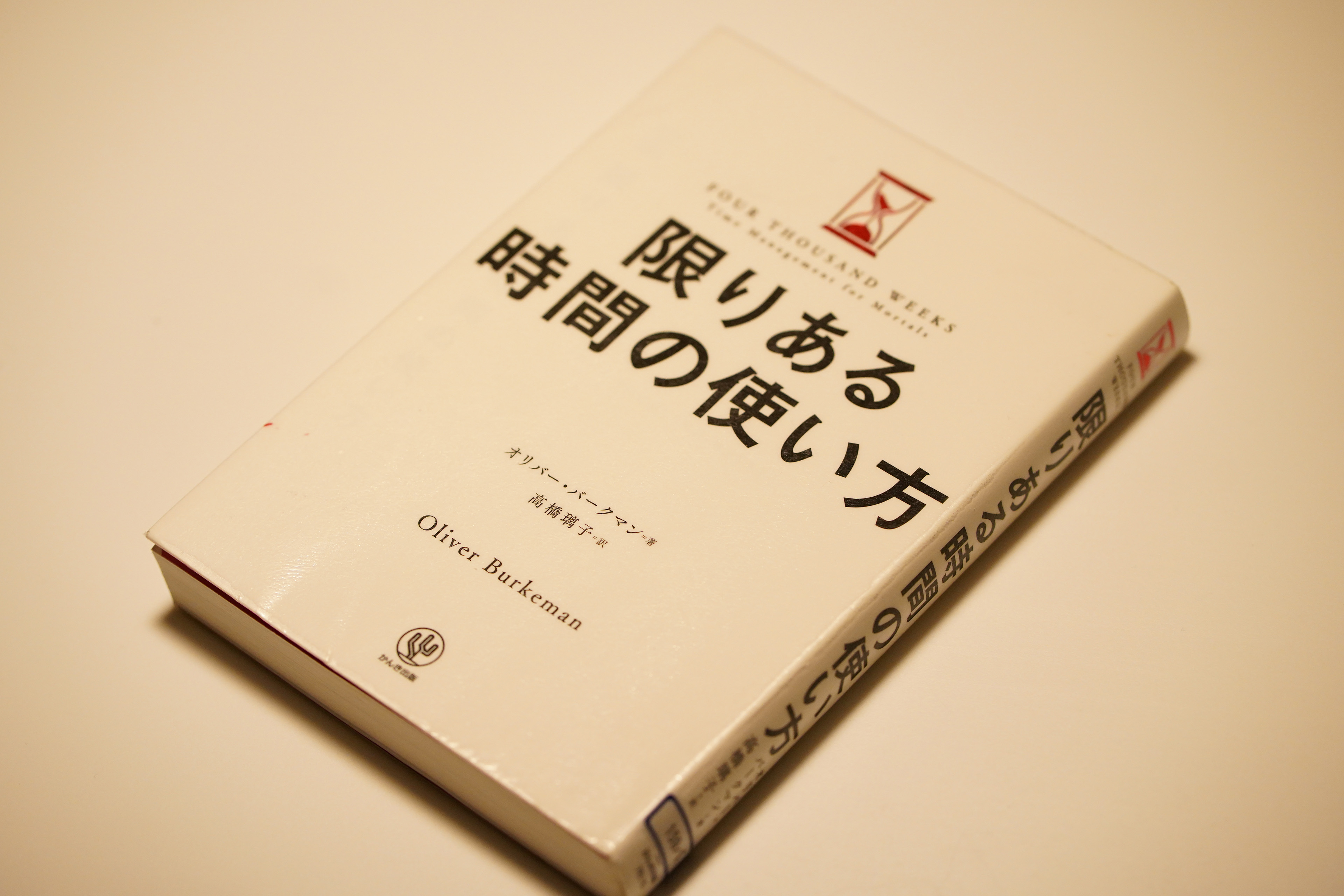
What I’m introducing this time is the shocking conclusion reached by journalist Oliver Burkeman, who called himself a productivity geek — “Four Thousand Weeks”.
This book is not just a time management book.
It is a book that shatters the illusion that we can control time, which we are unconsciously trapped in, and presents a mindset for truly living life.
- 1. The Shock of 4,000 Weeks — Life is Surprisingly Short
- 2. The Trap of Efficiency — The More Convenient, The Busier
- 3. The Joy of “Intentionally Choosing Not To” (JOMO) and the Resolve to “Settle”
- 4. Regaining “Patience” — Breaking Away from Speed Addiction
- Mindset Design—Pouring Everything into Time and Attention Because Life Is Finite
1. The Shock of 4,000 Weeks — Life is Surprisingly Short
Assuming we live to be 80, our life is only about 4,000 weeks.
How did you feel when you heard this number? Many people are speechless, thinking “Is that all?”
We usually behave as if we have infinite time. Our “bucket list” of things we want to do “when we have time” keeps growing.
However, the author thrusts a cruel truth upon us.
“It is impossible to get everything done.”
Admitting this is not defeat. It is rather liberation.
Because we are released from the obsession that “I must do everything” and can decide to “intentionally not do anything other than what is truly important to me”.
“Someday” Never Comes
We often tend to think, “Real life will begin once I get through this busyness.” Current time is just a preparation period for the future.
But this is an illusion.
Life is always nothing but a “series of nows”.
If you continue to sacrifice the present for the future, you will end your life while still “preparing” until the moment you die.
2. The Trap of Efficiency — The More Convenient, The Busier
Technology has evolved, and laundry, travel, and communication have become dramatically faster. So, has our leisure time increased?
The answer is NO.
“The more efficient you become, the more things you have to do.”
As emails arrive instantly, instant replies are now required.
People who work fast now attract even more work.
We are trying to frantically speed up bailing out water instead of plugging the hole in the bucket.
However, the sea water (tasks and information) is infinite. A finite human trying to win against the infinite is the true nature of modern “efficiency disease”.
“Efficiency” will never save us. Rather, efficiency is what binds us to the illusion of “someday” and deprives us of the ability to savor this very moment.
3. The Joy of “Intentionally Choosing Not To” (JOMO) and the Resolve to “Settle”
The desire to “do this and that” is endless. If you look at social media, you see countless options that others are enjoying (FOMO: Fear of Missing Out).
However, the author proposes this.
“Joyfully discarding infinite possibilities (JOMO: Joy of Missing Out)” is what makes life rich.
Kill Possibilities and Commit to Reality
As long as you keep looking at dating apps thinking “there might be someone better”, you cannot build a deep relationship with anyone.
As long as you keep looking at job sites thinking “there might be a job more suitable for me”, you will never immerse yourself in your current job.
Choosing one thing means discarding all other possibilities. That is scary.
However, only by discarding possibilities and “Settling” in reality does life show its depth.
“Only when you discard options and accept constraints does life begin to move.”
To take one best photo, you have to give up infinite compositions you didn’t take.
Those who try to have everything end up having nothing.
4. Regaining “Patience” — Breaking Away from Speed Addiction
Modern people handle “waiting” no more. We watch videos at double speed and get irritated if loading takes 3 seconds.
We want to skip the process and get only the result.
Reality Does Not Go As You Wish
In an art history class at Harvard University, there is an assignment to make students stare at a single painting for 3 hours.
At first, it is boring and painful. But by taking time to keep looking, details, colors, and the painter’s intention that were invisible become visible.
It takes time to create something of value. It also takes time to nurture relationships.
Trying to force that speed up is violence against reality.
“Patience is not enduring an unpleasant situation. It is letting things take the time they need, as they are.”
Stop trying to control time and surrender yourself to the rhythm (speed) that the thing originally requires.
That is the only way to be released from impatience.
Mindset Design—Pouring Everything into Time and Attention Because Life Is Finite
Finally, from the perspective of Mindset Design, let’s reflect on what the finiteness of life teaches us.
Because Life Is Finite, Every Moment Carries Weight
A life of only 4,000 weeks is irreplaceable to me.
That is why I believe that deciding where to direct my time and attention is the most important choice in life.
I do not deny the will to want to become someone special.
In fact, I genuinely want to discover something that sets me apart from others.
This isn’t born from a need for external validation or wanting to be “recognized by the world,” but from a more fundamental desire: to view the world through my own unique lens and walk my own path.
“Life Should Be More Meaningful”
The words of environmental activist Charles Eisenstein, introduced in this book, struck a deep chord with me.
Life is supposed to be more fun, more real, and more meaningful. The world is supposed to be more beautiful. Even as a child, I thought so. It is wrong to hate Mondays and live waiting for weekends and holidays. It is wrong to have to raise your hand to be allowed to pee. It is strange to be locked indoors day after day on beautiful sunny days.
I resonate intensely with this sentiment.
Our youth—the time in life when we are most energetic, sensitive, and bursting with curiosity. To be forced to spend the majority of that precious time inside classrooms, bound by standardized curriculums and rigid timetables… when you think about it objectively, isn’t that an incredibly extravagant waste of life?
If life consists of only 4,000 weeks, we should be far more conscious of the gravity of spending several hundred of our brightest weeks in ways unrelated to our own will.
Time and Attention Are the Only Currency
The fact that life is finite is not a cause for despair. Rather, it is a reality that awakens a seriousness regarding our time and attention.
Precisely because time is limited, what we pay attention to determines life itself.
The 30 minutes lost to doom-scrolling on social media and the 30 minutes spent immersed in a favorite book are the same 30 minutes. However, the life that lies ahead after those minutes accumulate will be completely different.
Life is important to me. It should be to you, too.
That is why I want to use my time and attention—this finite resource that never returns—consciously and with care. That is the strongest message I received from this book.
Conclusion: Just Take the Next Step
In the limited time of 4,000 weeks, we cannot have it all.
However, only when we accept that “finitude” can we truly face the reality of the “here and now.”
Let’s stop sacrificing our present time for the sake of success in the distant future.
Let’s stop struggling to control a world that cannot be controlled.
We simply need to direct our attention, carefully and patiently, to the “things we must do” and the “things we want to do” right in front of us.
Because the accumulation of those moments—and nothing else—is what crafts the story of our lives.


Comment